
The techniques room: a unique educational space
This former sculpture studio, the spacious 60 m² Techniques Room has been a highlight for visitors to the Musée Bourdelle for many years. It has been completely redesigned to offer visitors of all ages educational features exploring the production process of artworks and the professionals of the studio. The aim of this new educational initiative is to help visitors understand of the complex process of creating a sculpture. Visitors are offered different levels of content, whether they are in a hurry or wish to deepen their knowledge of sculpting techniques.

One model, multiple casts
The central table is designed to convey, in just a few minutes, the key concepts involved in the creation of a single sculpture, through different materials and the corresponding stages of production. Virgin of the Offering by Bourdelle is thus presented simultaneously in clay, plaster, marble, and bronze. Alongside each version, a short animated film produced by the Sabir agency schematically explains the process involved in the successive stages: modelling in clay, casting in plaster, carving in marble or casting in bronze. This visual device is accessible to visitors with limited literacy skills and to foreign visitors. The tools associated with each of these techniques are also displayed alongside the works.

The hands-on wall
Located beneath the mezzanine, the interactive wall invites visitors to engage with certain concepts through experimentation and play. It combines original works designed to be touched, materials, and playful, audio and digital installations. The audiences it addresses are broad, from the toddlers' corner to adults keen to discover.

The children's corner
The museum provides young children with wooden building blocks to experiment with the three-dimensional composition of a sculpture. Puzzles created from drawings by Antoine Bourdelle offer a playful way to discover another facet of the sculptor’s work.

Original bronze sculptures to listen to, touch, and illuminate
Three original bronzes by Antoine Bourdelle are presented in the techniques room. They offer the public the opportunity to discover the works through touch. Two of them have been fitted with a specially designed device to enrich this experience. Visitors are invited to listen, without seeing the work, to a description of Daphne Transformed Into a Laurel Tree and to let their imagination run free. Subsequently, the unveiling of the work allows them to compare their mental image with Bourdelle’s interpretation and to touch the bronze in its finest details. In a similarly interactive way, visitors can discover the Head of Herakles under three distinct lighting conditions: chiaroscuro, low-angle light, or intense light, in order to understand the effect of lighting on the perception of a sculpture and its volumes.

Materials library
A materials library extends this sensory experience. Arranged on a lectern, several material samples offer a tactile discovery of the materials used in sculpture. Visitors can thus touch and feel the texture of terracotta or glazed clay, plaster, smooth marble or the marks left by tools, and raw or patinated bronze. The wide variety of materials and possible treatments is presented for visitors to see and touch.

Studio professionals cubes
While one might imagine the sculptor as a demiurge carrying out every stage of a sculpture’s creation, the reality is quite different. Antoine Bourdelle’s studio was bustling with models and numerous assistants to whom the sculptor entrusted the execution of certain highly physical and technical tasks. To help visitors understand the role of each of these key figures, the studio trades module consists of six mobile cubes. Visitors can try to identify the sculptor, the model, the moulder, the practitioner, the pointing machine operator, and the founder, and discover each one’s function and task in the creation of the final work.

Lost-wax casting techniques
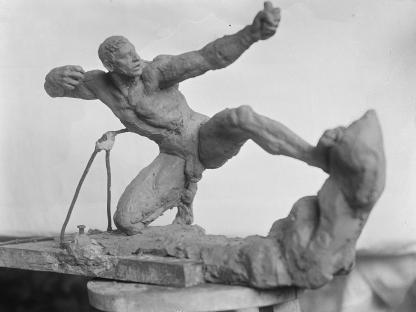
Complementary to the film dedicated to the sand casting technique shown in the central display case, this interactive digital device aims to explain, in the form of a game, the various stages of the process for creating a bronze using the lost-wax casting technique. The installation is divided into two parts: firstly, prototypes produced by the Coubertin foundry from a Head of Hercules the Archer; and secondly, a digital game presented on a touch screen in which visitors are invited to carry out step by step the key stages of the transition from an original plaster to the casting of a bronze, chased and patinated.


Multimedia lounge
A lounge area composed of three stations equipped with screens allows visitors to explore certain key themes of Bourdelle’s creative process through films and a new range of interactive and playful content designed by the Fleur de papier agency. Through interactive digital media, the modules address various themes that shed light on the creative challenges in the field of sculpture.
Monumental ! The Monument to General Alvear
Audiences are invited to follow step by step the creation of a monumental work, the Monument to General Alvear, produced by Antoine Bourdelle for the city of Buenos Aires (Argentina). How does he structure the composition? How does he conduct his research? In what dimensions does he work? How does he progressively enlarge his work?
Hercules the Archer: Spreading a Masterpiece
The audiences explore the concept of the multiple in sculpture in a practical way, through the dissemination of various copies of Bourdelle’s masterpiece, Hercules the Archer. The context of each commission is explored in dedicated chapters: The will of a patron, Hercules at the salon, Prestigious collectors, A museum piece, Hercules as a monument… all the way to dissemination through reproduction, on the famous school exercise books!
Sculpture without end, Re-use and multiples
This theme addresses the notion of a laboratory of forms, centred on the research conducted for the commission of the War Memorial of Montauban, as well as the variations and the creation of independent works to which this project gave rise. Visitors will also be able to view documentaries on bronze casting, point-carving and the technique of enamelling.
En savoir plus

Don't miss any news from the Bourdelle Museum.
Subscribe to our monthly newsletter