
Past exhibition
Rodin / Bourdelle. Corps à corps
From 2 October 2024 to 2 February 2025
Full rate : 10 €
Reduced rate : 8 €
Online booking is strongly recommended.
The exhibition is open Tuesday to Sunday, 10 am - 6 pm (last entry at 5:15 pm)
Late-night opening every Friday until 8 pm (last entry at 7:15 pm)
Antoine Bourdelle (1861–1929) admired Auguste Rodin (1840–1917), twenty years his senior. For fifteen years, he worked in Rodin's studio as a praticien, charged with carving marbles for Rodin. The master perceived in this heir, willingly unruly, an "explorer of the future."
Parallel and often overlapping, their trajectories certainly merit a major exhibition. Through more than 160 works — 96 sculptures, 38 drawings, 3 paintings, and 26 photographs — the exhibition reveals, with unprecedented ambition and scope, the affinities and reciprocities as well as the divergences and antagonisms of two creators, two sculptural worlds, bearing the defining stakes of modernity.
The exhibition benefits from the exceptional support of the musée Rodin which lends 60 works from its collections, as well as loans from numerous international institutions. The musée national d'art moderne / Centre de création industrielle / Centre Pompidou, the musée d'Orsay, the Maison de Balzac, the musée du Petit Palais, musée des beaux-arts de la Ville de Paris, the musée des Beaux-arts de Lyon, the musée des Beaux-arts de Rouen, the musée Matisse de Nice, the musée départemental Matisse du Cateau-Cambrésis, the Ateliers-Musée Chana Orloff, the Fondation Giacometti in Paris, the Alberto Giacometti-Stiftung Kunsthaus in Zürich and the Ny Carlsberg Glyptotek in Copenhagen have also contributed their generous support to this exhibition.
Introduction | Tributes and filiations
As a prelude to the exhibition, an introductory section establishes the tutelary relationship between the two artists through a focused selection of photographs, drawings given by Rodin to Bourdelle, and sculptures donated by Bourdelle to the Musée Rodin. Here one senses the weight of artistic filiation, as well as the shared and enduring reference to Michelangelo. Throughout his life, Bourdelle kept a composite portrait of himself alongside one of Rodin, a souvenir of the period during which he works regularly for him.
Bourdelle began a portrait of Rodin in 1904. In the summer, he asks him for posing sessions, interrupted by the master. Bourdelle nevertheless manages to complete two sculptures of Rodin in 1910. Rodin at Work depicts him standing before a fragment of the Gates of Hell, a large compass in hand. The herm-shaped bust shown at the Salon of the Société nationale des Beaux-Arts was later truncated at the base by Bourdelle himself, who nevertheless retained the inscription: "To the master Rodin, these assembled profiles." If the reference is flattering, the dedication nonetheless asserts the will to geometrize volumes and to architecturize forms, far from the Rodinian modelling.

In 1881, Rodin received from the Beaux-Arts administration a commission for two monumental figures of Adam and Eve, intended to flank the Gates of Hell. Shown at the Salon of 1881 under the title The Creation of Man, the figure of Adam makes explicit reference to the muscular nudes of Michelangelo's celebrated Ignudi, painted on the ceiling of the Sistine Chapel in Rome (1508–1512). Pointing toward the ground, Adam appears to tear himself painfully from the primal earth. Seven years later, Bourdelle approached the same subject in an academic style strongly marked by Michelangelo. The gesture of despair follows the canonical iconography of Adam, crushed beneath the weight of original sin.

Section 1 | The soul of the material
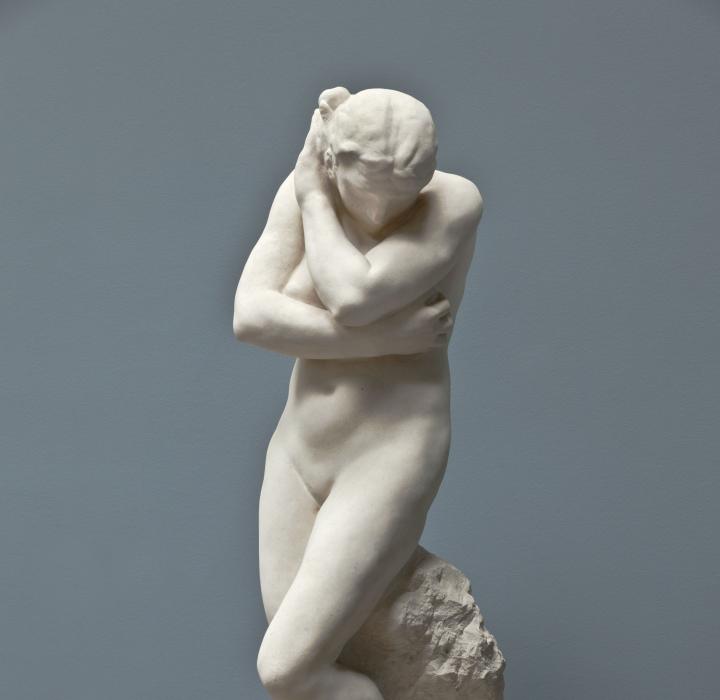
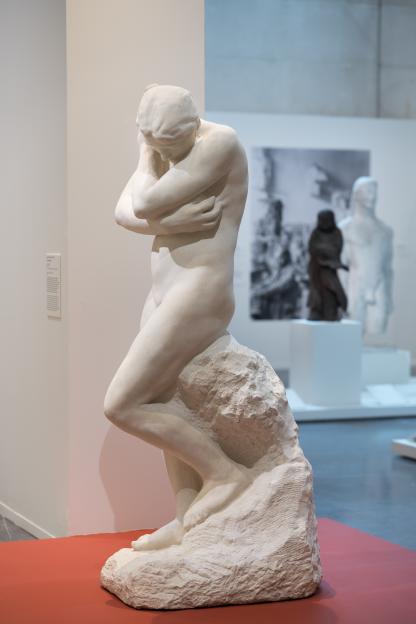
The first section examines the role of the praticien, exploring why and how Bourdelle became Rodin's "hands", transcribing the master's plaster models into stone, among which the magisterial Eve (an exceptional loan from the Ny Carlsberg Glyptotek in Copenhagen) stands as the ultimate masterpiece. The section also speaks to the mutual fascination both men held for marble and the aesthetics of the unfinished.
Bourdelle, praticien of Rodin
The nephew of a stonemason and the son of a cabinetmaker, Antoine Bourdelle learned the craft of working with materials from an early age. Auguste Rodin first encountered the work of his younger colleague at the Salon of the Société nationale des Beaux-Arts in 1892. Besieged by commissions, Rodin then had about ten praticiens working for him, and solicited Bourdelle.
Between 1893 and 1907, Bourdelle carved around ten marble works for Rodin at his studios — now the Musée Bourdelle — assisted by his own praticiens and students. Desirous of being more than a simple executor, he proposed to assist him with the foundries. Rodin, in turn, supported the young sculptor, notably in the case of the Monument to the Fighters of Montauban, marked by a distinctly Rodinian expressivity. In 1902, the first tensions emerged: Bourdelle was taking too long to carve Eve, and his proposed composition for the bust of Rose Beuret was rejected by Rodin. Yet their collaboration continued for several more years. In March 1908, Bourdelle was finally able to write: "I have at this moment a great deal of work. I no longer need to work for Rodin. I am selling a great deal."
Having received the stone to carve in his studios in 1893, Bourdelle received several personal commissions that delayed his execution. He worked on it intermittently from 1901, pressed by Rodin. Bourdelle restituted even the imperfections of the skin and refrained from smoothing too much every square centimetre of the limestone become flesh of this figure born from Rodin's reflections for the Gates of Hell.
Interlude : Rodin and Bourdelle as collectors
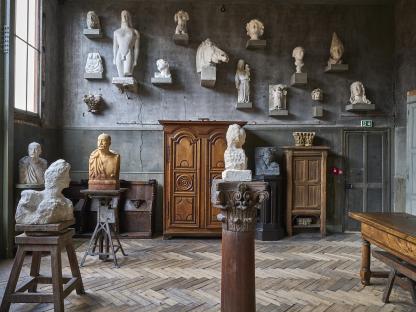
Rodin and Bourdelle were both enthusiastic collectors. Selected from their respective collections, a significant group of works testifies to their aesthetic fraternity as well as their insatiable curiosity: beyond Greco-Roman antiquity, Egyptian, Hindu, Japanese, Persian works, medieval objects of art and sculptures give matter to dream and to create…
Section 2 : Aesthetics of the fragment
This second section explores the sculptural expressivity of the "body in pieces" — head, hand, torso — a form to which Rodin was the first to grant full artistic legitimacy.
A group of masks serves as a reminder that this striking distillation of the human figure was widely embraced by both sculptors in their pursuit of synthetic expression and powerful symbols.
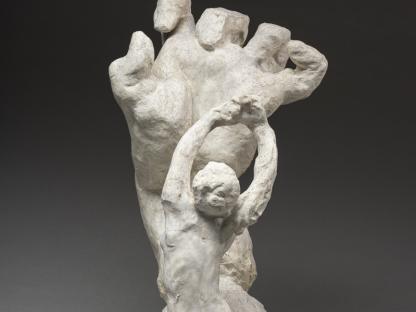
Hands alone can encapsulate the entire spirit of a composition — to the point that some were rendered in marble, such as Rodin's The Hand of God (1898–1902), or cast in bronze, such as Bourdelle's Desperate Hand (1900). In the eyes of both artists, they represented "a portrait in action."
From the vibrant surface of modelling to the geometrization and synthesis of form, the torso establishes an exemplary dialogue between plasters and bronzes by Rodin and Bourdelle, and the radical figures of Raymond Duchamp-Villon (1876–1918), Constantin Brancusi (1875–1957), Alberto Giacometti (1901–1966), Ossip Zadkine (1888–1967), and Chana Orloff (1888–1968). A temporal breakthrough in which the torso asserts itself as a totem of modernity.
Section 3 : The monument(al)
The third section poses the question of the deployment of sculpture in space. Initiated by Rodin, pursued by Bourdelle, the explorations around the pedestal attest to their desire to rethink and multiply proportions. In contrast, the confrontation of the Gates of Hell and the Monument to Balzac of the first, and the façade of the Théâtre des Champs-Élysées and the monument of La France of the second, offer a complete sculptural antithesis. To Rodin's vitalist swarming, Bourdelle opposes his capacity to contain, master and architecturize form.
Section 4 : Metamorphoses and hybridizations
The final section turns to centaurs, centauresses(female centaurs), and the symbiosis of the animal, the vegetal, and the human… Rodin and Bourdelle drew from the inexhaustible reservoir of mythology to explore and liberate, in drawing as in sculpture, the inexhaustible potentialities of form.
Epilogue
The exhibition closes with an exploration of the standing figure in the lineage of Rodin's Walking Man: Bourdelle's Self-Portrait without Arms, Henri Matisse's The Serf, Germaine Richier's Walking Man, and Alberto Giacometti's Man Crossing a Square together illuminate the lasting legacy of the Rodinian expressionist tradition and the Bourdellian synthesis.
This part therefore aims to underline the influence of the two masters at the source of the avant-gardes, with in counterpoint, works by Henri Matisse (1869–1954), Constantin Brancusi (1876–1957), Raymond Duchamp-Villon (1876–1918), Ossip Zadkine (1888–1967), Chana Orloff (1888–1968), Alberto Giacometti (1901–1966), Germaine Richier (1902–1959).
Touring Exhibition
The exhibition will be presented at La Piscine – Musée d'art et d'industrie André-Diligent, Roubaix, 1 March – 1 June 2025, then at the Musée Ingres Bourdelle, Montauban, 27 June – 19 October 2025.
General Curator
Ophélie Ferlier Bouat, Chief Curator of Heritage, Director of Musée Bourdelle
Scientific Curators
Jérôme Godeau, Exhibition Curator and Art Historian, Musée Bourdelle
Colin Lemoine, Curator of Photography and 20th–21st Century Collections, Musée Bourdelle
Véronique Mattiussi, Head of Research, Musée Rodin
Valérie Montalbetti-Kervella, Curator of Sculpture, Musée Bourdelle
Lili Davenas, Curator of Drawings and Paintings, Musée Bourdelle
The exhibition benefits from the exceptional support of the musée Rodin which lends 60 works from its collections, but also from loans from numerous international institutions. The musée national d'art moderne / Centre de création industrielle / Centre Pompidou, the musée d'Orsay, the Maison de Balzac, the musée du Petit Palais, musée des beaux-arts de la Ville de Paris, the musée des Beaux-arts de Lyon, the musée des Beaux-arts de Rouen, the musée Matisse de Nice, the musée départemental Matisse du Cateau-Cambrésis, the Ateliers-Musée Chana Orloff, the Fondation Giacometti in Paris, the Alberto Giacometti-Stiftung Kunsthaus in Zürich and the Ny Carlsberg Glyptotek in Copenhagen have also contributed their generous support to this exhibition.
Practical Information
The museum is open Tuesday to Sunday from 10am to 6pm. Last entry to the exhibition 5:15pm.
Late-night opening / on Fridays the exhibition is open until 8pm. Last entry to the exhibition 7:15pm
Musée Bourdelle
18, rue Antoine-Bourdelle
75015 Paris
Tel. : +33 (0)1 49 54 73 73
www.bourdelle.paris.fr
Follow us!
@MuseeBourdelle
#MuseeBourdelle
#ExpoRodinBourdelle


Télécharger le communiqué de presse de l'exposition (PDF - 818.9 Ko)
Télécharger le dossier de presse de l'exposition (PDF - 3.3 Mo)
Pour aller plus loin

Don't miss any news from the Bourdelle Museum.
Subscribe to our monthly newsletter